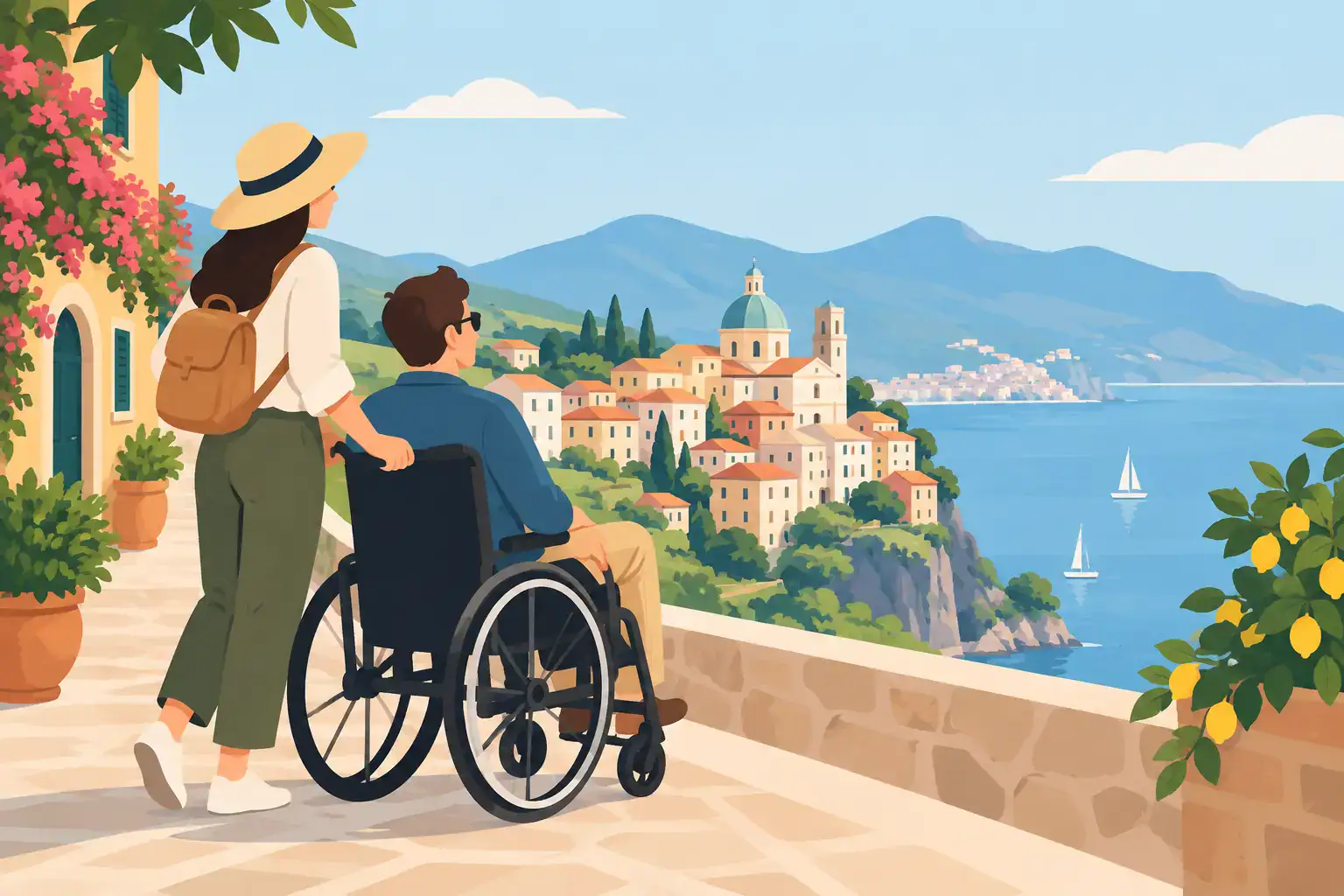

A beautiful coastal holiday should begin with anticipation, not uncertainty. This accessible travel guide is designed for travellers who want to enjoy Liguria at their own pace, whether that means planning around reduced mobility, travelling with a wheelchair or walking aid, managing sensory needs, or simply choosing a stay with fewer unnecessary complications.
Accessibility is personal. A feature that makes one guest feel free may not meet another guest’s needs, so the most rewarding holidays are planned around the details that matter to you: the route from arrival to room, the gradient of paths, bathroom layout, pool access, dining arrangements and the space to rest between memorable moments. On the Riviera dei Fiori, a little thoughtful preparation makes room for the things that should take centre stage: sea air, unhurried meals, warm light and time together.
Before choosing a destination or room, define what a comfortable day looks like for you. Is step-free access essential from the car to reception and from reception to your accommodation? Do you need a roll-in shower, grab rails, a shower chair, a bed at a particular height or space to turn a wheelchair? Perhaps your priority is somewhere quiet, with the option to retreat after a busy outing.
It also helps to separate essential requirements from preferences. Essential needs are the details without which a stay will not work safely or comfortably. Preferences may include a terrace, sea view, separate sleeping areas for family members, proximity to the restaurant or the independence of self-catering accommodation. Sharing both with the property allows the team to suggest the most suitable option rather than simply the room category that looks best in photographs.
If you are travelling with a companion, discuss the practical rhythm of the holiday together. One person may be happiest exploring a historic town, while another needs regular rests in the shade. The right resort setting can make that balance easier, offering places to pause, dine and relax without every hour requiring a journey.
The word “accessible” can cover a wide range of facilities, so broad questions often lead to broad answers. A more useful approach is to ask for measurements, photographs and a clear description of the route you will actually use.
Ask whether there are steps at any point between parking, arrival, your room, restaurants, pool areas and communal spaces. Check the width of doorways, whether a lift is available where needed, the surface of outdoor paths and whether slopes are gentle or steep. For bathrooms, ask about the shower threshold, toilet clearance, handrails and room for a carer to assist.
For guests who use mobility equipment, it is worth confirming where it can be stored and charged. For those with visual or hearing impairments, ask how staff can support arrival, orientation and emergency procedures. If travelling with children, older relatives or a dog, include their needs too. A holiday feels far more spacious when nobody has to improvise at every turn.
Written confirmation is useful, particularly when a particular feature is essential. It creates clarity for both guest and hotel, and gives the property an opportunity to prepare properly before you arrive.
A well-planned room is only one part of an accessible stay. Liguria’s beauty comes with its character: hillside villages, cobbled lanes and panoramic views can involve gradients, uneven surfaces and narrow passages. That does not make the region off limits. It simply means that the experience should be shaped with care.
Choose days that match your energy. A scenic drive, a relaxed lunch overlooking the coast or time beside the pool can be every bit as memorable as a packed itinerary. If you would like to visit towns such as Imperia, ask locally about accessible parking, drop-off points and the most manageable promenades before setting out. Morning and late afternoon are often more comfortable than the heat of midday, especially during the summer season.
The most comfortable holiday accommodation creates flexibility. For some guests, that means a hotel room close to shared facilities. For others, a suite or residence-style space offers the freedom to rest, prepare a light meal, keep medication or specialist equipment organised, and follow a familiar routine.
Look beyond the label of a room category. Consider its position within the resort, outdoor access, distance to dining and whether the layout supports your group. Families may value separate sleeping areas and enough room for a pushchair, mobility aid or cot. Couples may prefer privacy and the option of a slower morning. Travellers with fluctuating energy levels may appreciate having a comfortable terrace or lounge space nearby rather than feeling obliged to go out each time they want fresh air.
At Villa Giada SpEace Resort, the idea of space is central to the experience: room to share a family meal, take a quiet pause, enjoy the outdoors and shape each day around your own rhythm. Availability and suitability always depend on the specific accommodation and individual requirements, so a direct conversation before booking is the best way to match expectations with the right stay.
Dining is one of the great pleasures of an Italian holiday, and it should not become a source of anxiety. Let the property know about allergies, intolerances, dietary requirements or texture-modified meals before arrival, allowing enough time for a thoughtful response. Be clear about the seriousness of an allergy and any cross-contamination concerns.
Meal flexibility matters, too. A later breakfast, an earlier dinner, the chance to dine close to your room or a self-catering option can make a significant difference when medication, fatigue, young children or care routines influence the day. Rather than building every outing around a restaurant reservation, leave space for a relaxed lunch, a light supper or a quiet evening when that feels right.
The travel day is often the most demanding part of an accessible holiday. Build in more time than you think you need, particularly for airport assistance, car hire, transfer connections or rest stops. If you require passenger assistance on a flight or train, arrange it when booking and reconfirm it before departure.
For car travel, identify accessible stops along the route and keep essentials within easy reach: medication, water, chargers, a change of clothes and any paperwork related to equipment or medical needs. If hiring an adapted vehicle or arranging a transfer, confirm the type of vehicle, luggage capacity, whether a wheelchair can remain occupied during transport where relevant, and who will assist with loading.
It is also sensible to bring a small document with key information in Italian as well as English. Include relevant medical details, emergency contacts, allergies and the make or model of essential equipment. This is not about expecting difficulty. It is about travelling with the quiet confidence that good preparation brings.
Accessible travel is not a lesser version of travel. Often, it is a more attentive way to experience a place. When you allow time for a long breakfast, a swim or poolside pause, a view from the terrace, or a sunset aperitivo, the holiday becomes less about covering ground and more about feeling present within it.
Avoid planning a full day for every day. Alternate an outing with a resort day, and have a gentle indoor or nearby option ready in case weather, energy or mood changes. If wellness facilities appeal, ask in advance about access routes, changing areas, treatment arrangements and any assistance that may be available. A private experience may offer greater comfort for guests who value privacy, predictable timing or a calmer environment.
For families, a slower pace can be especially valuable. Children do not need every hour programmed, and adults deserve time to reset. Choosing a destination with food, leisure areas and opportunities for all ages close at hand reduces the pressure to keep moving simply to make the holiday feel worthwhile.
The best accessible holidays are built as a partnership between traveller and host. Share your needs early, ask direct questions and be honest about what will make you feel secure. In return, look for a team that answers specifically, never makes assumptions and understands that dignity is as important as convenience.
Your Italian holiday does not need to follow anyone else’s pace. Choose the route that feels comfortable, reserve energy for the moments you value most, and let the Ligurian coast meet you with sunlight, flavour and the freedom to simply be.
Idee, esperienze e ispirazioni per il tuo prossimo soggiorno.