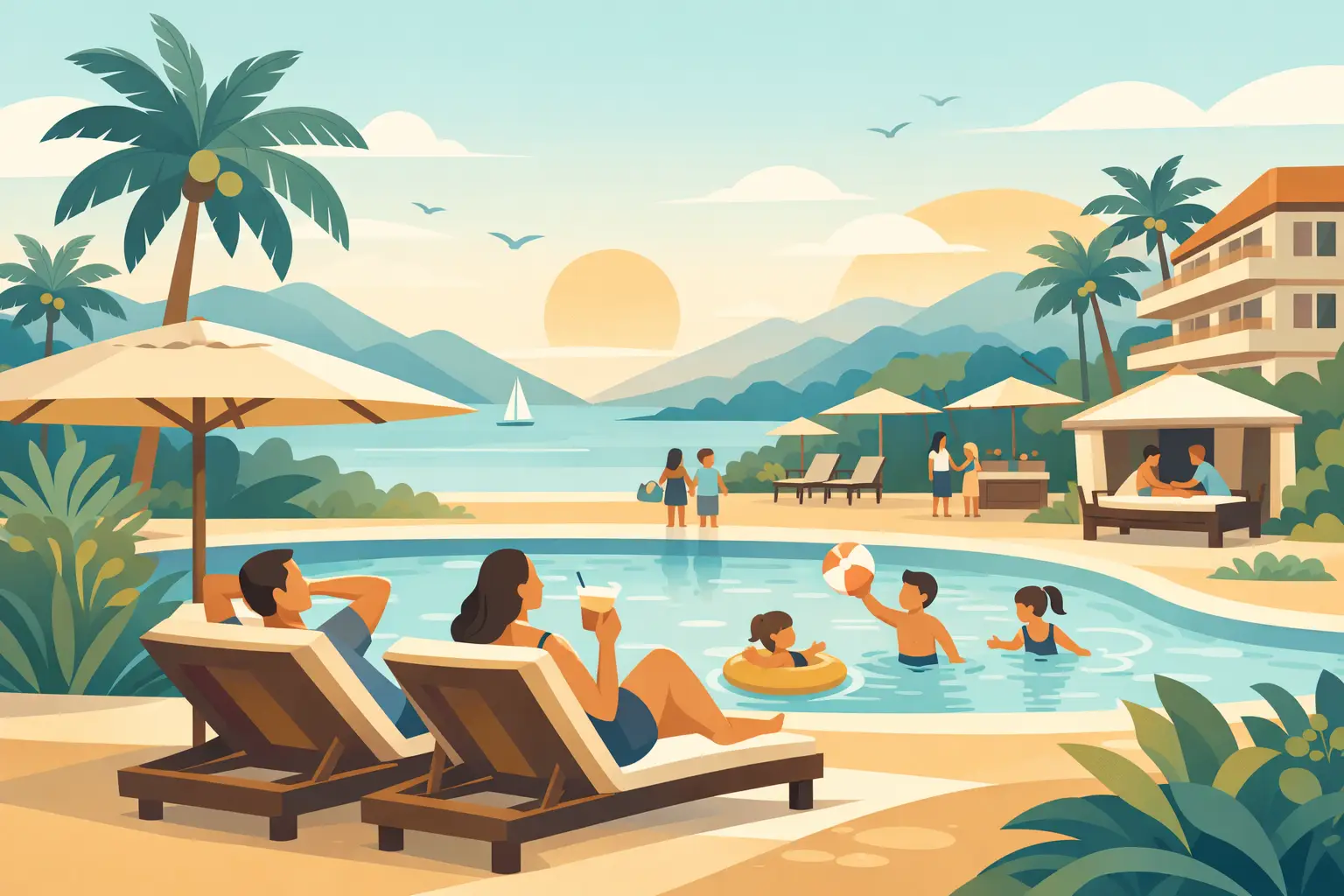
A family holiday can fall apart in surprisingly ordinary ways. The room feels too tight by day two. Meals become a negotiation. Parents want calm, children want movement, and everyone is working around a layout that was never designed for real family life. A true family resort solves those tensions before they begin, not with louder entertainment or bigger promises, but with space, rhythm and choice.
That difference matters more than ever for travellers who want their time away to feel restorative rather than scheduled. The best stays are not built around keeping everyone busy every minute. They are built around giving each guest enough freedom to enjoy the same holiday in their own way.
Families rarely need more stimulation. They need a setting that removes friction. That starts with the basics – where you sleep, how you eat, how children play, how adults rest, and whether the day can change shape without becoming complicated.
A well-designed family resort understands that comfort is not only about quality furnishings or attractive views. It is about being able to move through the day without constant compromise. If one child needs a nap while another wants the pool, if parents want an unhurried dinner after an active morning, or if a dog is part of the plan, the resort should make those moments feel natural.
This is where many properties separate into two very different categories. Some are suitable for families in the sense that children are allowed and basic services exist. Others are genuinely structured around family living, where larger accommodation, outdoor areas, flexible dining and varied experiences combine into something more complete.
Space changes the mood of a holiday. It affects sleep, privacy, noise levels and how long a stay remains enjoyable. A compact room may work for a night or two, but a longer break often calls for something more generous – not only more beds, but more breathing room.
For families, that can mean separate sleeping areas, room to unpack properly, terraces or gardens that extend daily life outdoors, and accommodation options that adapt to different ages and routines. Younger children may need closeness. Teenagers often need more independence. Parents, meanwhile, usually want a little privacy without feeling disconnected.
The most appealing resorts understand this balance. They offer room categories that do not force every family into the same formula. A couple travelling with a baby does not need the same layout as a larger family staying for a week by the sea. Flexibility in accommodation is not a minor detail. It is often what determines whether the holiday feels restful or crowded.
Children remember movement. Parents remember whether they had a chance to stop.
That is why the most successful family settings combine activity with calm. A pool is not simply a pool. Its value depends on how it fits into the wider atmosphere. Is there enough room around it? Can children enjoy it safely without every adult conversation becoming impossible? Are there sunlit spaces for social time and quieter corners for reading, resting or simply listening to the water?
The same principle applies to gardens, terraces and shared lounges. Families enjoy having places to gather, but they also benefit from having somewhere to step back. A resort with generous outdoor space tends to feel more relaxed because no one is competing for comfort.
This is especially true on the Ligurian coast, where climate and scenery invite guests to spend more of the day outside. A family resort in this setting should not keep nature at the edge of the experience. It should bring it into daily life, through sea air, hillside views, open spaces and the sense that the holiday can unfold at its own pace.
Food shapes the tone of a stay more than many guests expect. When dining is rigid, the entire day becomes rigid with it. Families often want quality, but they also want options.
Some mornings call for a generous breakfast before an excursion. Some evenings deserve a leisurely dinner on property. On other days, independence feels better – especially for guests who enjoy alternating beach time, sport, local exploration and slower hours by the pool.
A good family resort does not treat this as indecision. It treats it as the reality of holiday living. Flexible meal formulas are often far more valuable than a one-size-fits-all board basis. They allow families to keep spontaneity while still enjoying the ease and pleasure of well-prepared food when it suits them.
There is also an emotional side to dining that should not be underestimated. Shared meals are often where the best moments settle. Children talk about the day. Parents finally exhale. Local flavours become part of memory. In a resort environment, dining should feel like an extension of the holiday mood – generous, flavourful and easy – not another timetable to manage.
One of the oldest mistakes in family hospitality is assuming that if children are happy, the job is done. In reality, families book their best breaks when everyone is considered.
Parents are not looking to disappear into the background of their own holiday. They want beauty, comfort and moments that feel distinctly theirs. That may mean a private spa experience, a peaceful terrace, a refined dinner, or the quiet pleasure of waking up somewhere that feels spacious and cared for.
When a resort manages this well, the atmosphere changes. The stay no longer feels like a child-centred trip with practical compromises for adults. It feels like a proper holiday shared across generations.
This is one reason wellness fits naturally within the best family-focused properties. Not because every guest wants a full spa programme, but because wellbeing has become part of how people choose where to stay. Rest, privacy, good sleep, time outdoors, better food and moments of calm all contribute. A resort that understands this can appeal to families without losing sophistication.
There is a common assumption that family travel must be packed with constant activities to be successful. For some guests, that works. For many others, it does not.
A more refined family resort offers support without pressure. It gives guests enough to enjoy, while leaving room for choice. A morning swim, a beach outing, lunch at leisure, a walk in the hills, an hour in the spa, dinner as the light softens – this kind of day feels richer because it is not over-directed.
The strongest hospitality concepts recognise that luxury often means freedom. The freedom to self-cater or dine out. The freedom to spend one day active and the next almost entirely still. The freedom to travel with children, a partner, grandparents or a dog without feeling that one part of the group has been awkwardly added to the plan.
That is where a resort model becomes especially attractive. It offers the services of a full stay, but with enough flexibility to feel personal.
A family resort can have excellent facilities and still feel generic if its location is treated as scenery rather than substance. The most memorable stays are shaped by place.
On the Riviera dei Fiori, that means more than sea views. It means a holiday suspended between coast and hills, between beach time and outdoor adventure, between long lunches and active afternoons. Families who enjoy walking, cycling or simply being outside tend to value destinations where nature is easy to reach rather than something that requires effort to access.
It also means the atmosphere of the region should be present in the experience itself – in the food, the light, the pace, the sense of openness. At its best, a resort becomes a gateway to the character of the destination while still offering the comfort of a private retreat.
This balance is part of what gives Villa Giada SpEace Resort its appeal. The idea of spaciousness joined with peace is not only a brand philosophy. For many families, it is exactly what they have been looking for without always naming it so clearly.
The right choice depends on what kind of ease you value most. Some families prioritize large accommodation and self-directed days. Others place dining, pools and on-site wellbeing at the centre of the experience. For active travellers, practical support for sport and outdoor exploration may be just as important as the room itself.
It is also worth being honest about the pace you want. If your ideal break includes privacy, quality food, flexible routines and enough space for everyone to settle properly, a more thoughtful resort setting will usually serve you better than a standard hotel. If you prefer constant entertainment and tightly programmed days, you may be looking for something else entirely.
The best family resort is not the one that tries to be everything. It is the one that makes your kind of holiday feel natural from the moment you arrive.
When a place offers that rare mix of comfort, freedom and beauty, the whole family feels the difference. Children play more easily, adults relax more fully, and time together becomes less about logistics and more about living well for a few precious days.